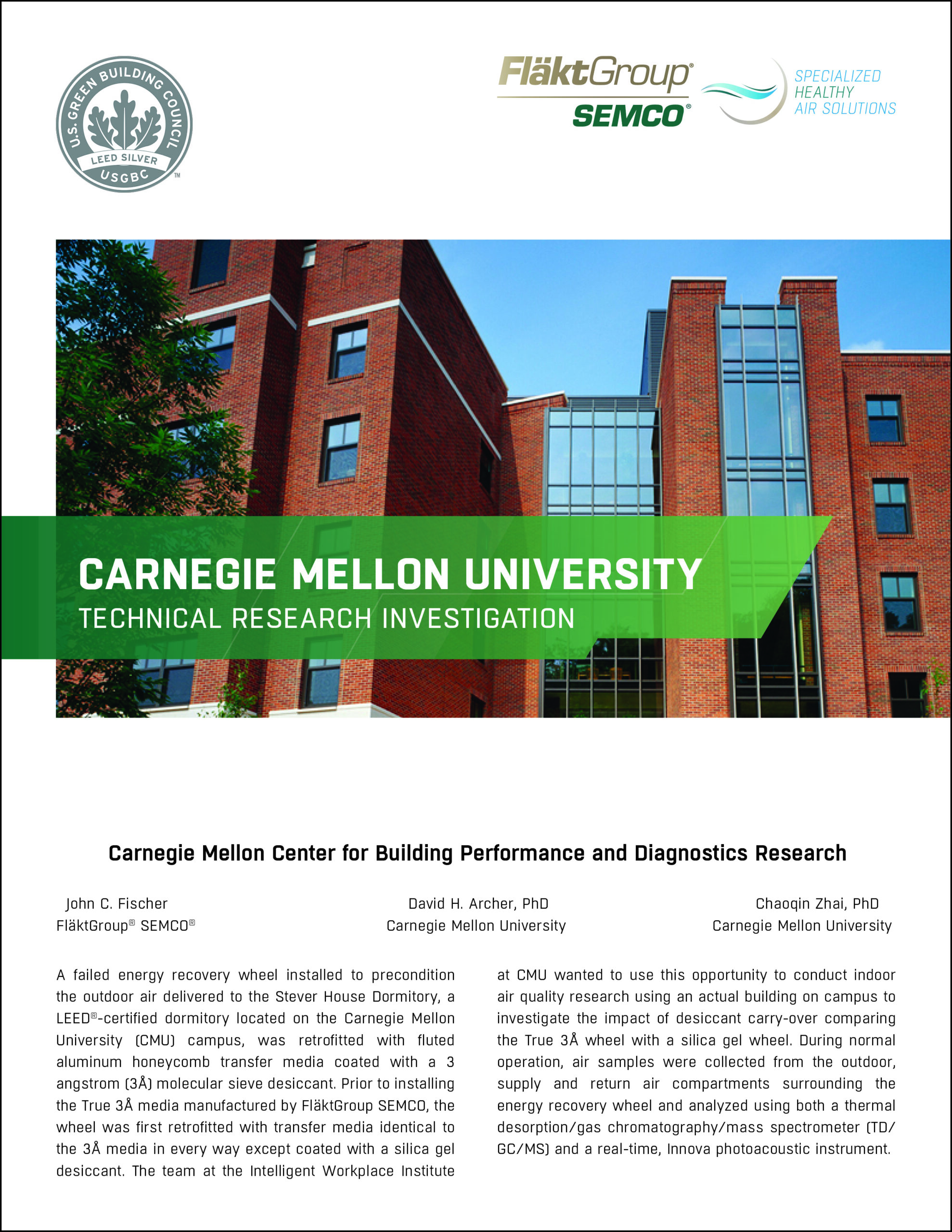
Carnegie Mellon: Stever House Dormitory
- Pittsburgh, Pennsylvania
A failed energy recovery wheel at the LEED‑certified Stever House dormitory was retrofitted to investigate the impact of desiccant carry‑over on indoor air quality. The project compared silica gel and True 3Å molecular sieve desiccant media using full‑scale testing within the building. The outcomes demonstrated differences in contaminant transfer and resultant indoor air quality.
Key Facts
- LEED‑certified dormitory
- Original failed wheel replaced with fluted aluminum honeycomb media
- Two media types tested: silica gel and True 3Å molecular sieve
- Testing conducted during two seasons (June 2007 and January 2008)
- Air samples taken from outdoor, supply, and return air streams
- True 3Å wheel showed no detectable contaminant carry‑over
- Silica gel wheel exhibited approximately 31% contaminant transfer in Phase 1
- Silica gel wheel resulted in a 54% higher indoor contaminant level compared to 3Å wheel in Phase 1
- Phase 2 silica gel wheel showed 43% TVOC carry‑over and 27% CO₂ carry‑over
- Phase 2 True 3Å wheel demonstrated 0% carry‑over
- 68% latent recovery observed with True 3Å wheel in heating season
Challenge
The failed silica gel energy recovery wheel compromised performance and created an opportunity to investigate whether different desiccant materials would affect contaminant transfer and indoor air quality in the Stever House dormitory.
Solution
New transfer media sections were installed using fluted aluminum honeycomb, first coated with silica gel and then with a True 3Å molecular sieve desiccant. Air samples were collected and analyzed using TD/GC/MS and a real‑time photoacoustic instrument to compare contaminant carry‑over. Additional testing included a secondary CMU facility served by a silica gel wheel.
Results
- True 3Å wheel: No detectable contaminant carry‑over
- Silica gel wheel: Approximately 31% contaminant transfer in Phase 1
- Indoor TVOC levels were 54% higher with silica gel wheel in Phase 1
- Phase 2 True 3Å wheel maintained 0% carry‑over
- Phase 2 silica gel wheel showed 43% TVOC carry‑over and 27% CO₂ carry‑over
- True 3Å wheel provided 68% latent moisture recovery
- Silica gel wheel compromised indoor air quality at both tested facilities
Plan your next Education project with healthier, more efficient air.
We help engineers and owners design low-energy, code-compliant systems — backed by real-world results like this case.