
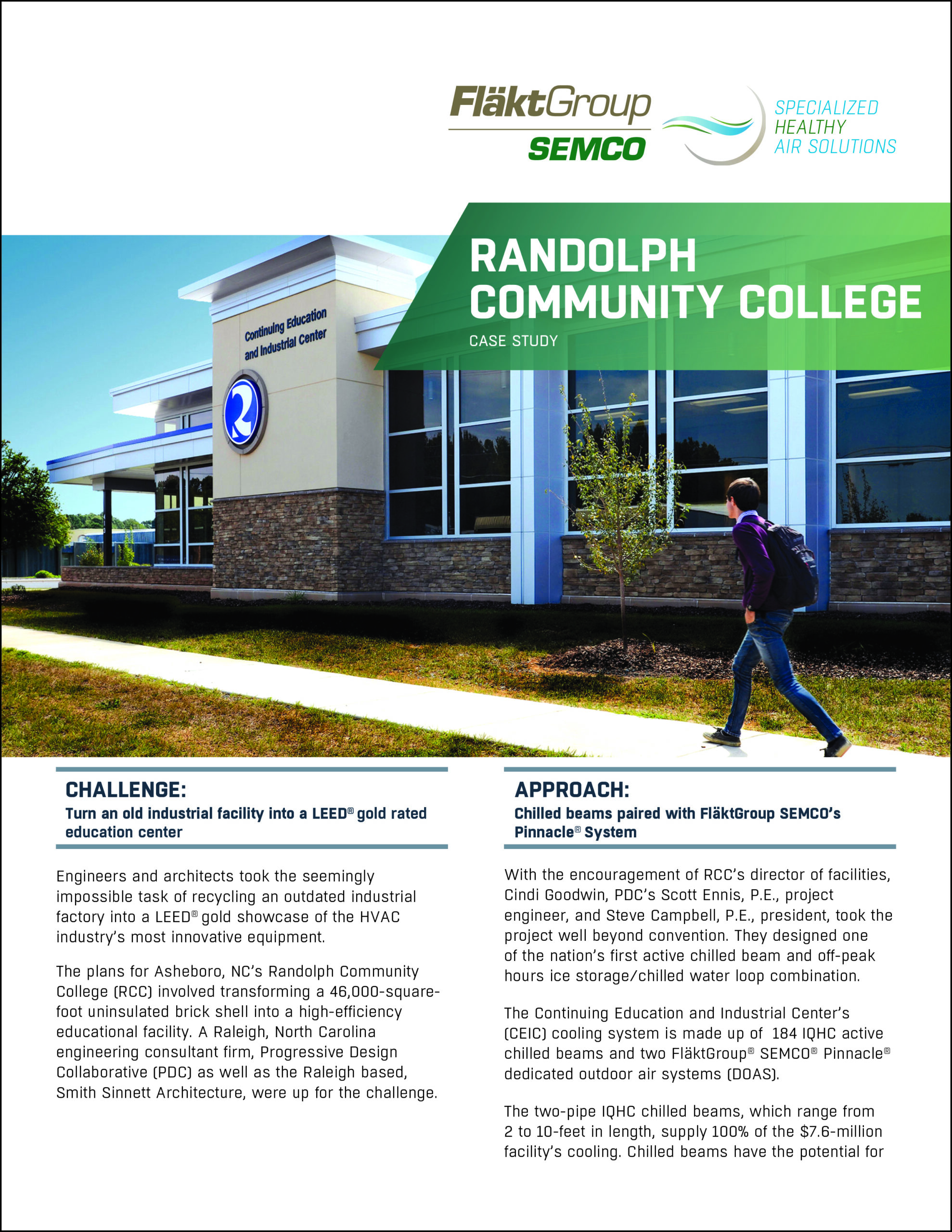
Randolph Community College: Continuing Education and Industrial Center
- Asheboro, North Carolina
Randolph Community College transformed a 46,000‑square‑foot uninsulated industrial facility into a high‑efficiency education center. Engineers incorporated active chilled beams and Pinnacle DOAS units to address the project’s requirements for energy efficiency, ventilation, and humidity control. The resulting system contributed to substantial energy savings and LEED® Gold certification.
Key Facts
- 46,000‑square‑foot former industrial brick shell
- 184 IQHC active chilled beams installed
- Two FläktGroup SEMCO Pinnacle® DOAS units (10,000 CFM each)
- Two‑pipe chilled beam system supplying 100% of cooling
- Off‑peak ice storage/chilled water loop incorporated
- Project cost: $7.6 million
- 28.2% energy savings versus conventional rooftop/VAV designs
- Four‑year payback achieved (including $60,000 Duke Energy rebate)
- LEED 2.2 project: 7 of 41 credits attributed to HVAC system
- First LEED® Gold certified building in Randolph County (June 2013)
- Small six‑inch‑diameter ductwork enabled reduced plenum height R‑value improvements: walls increased from R‑3.45 to R‑14; roof from R‑7.17 to R‑30 Building automation features including EcoRate dashboard
Challenge
Turn an old industrial facility into a LEED® Gold rated education center.
Solution
The project employed 184 IQHC active chilled beams paired with two Pinnacle® DOAS units, creating one of the first combinations of chilled beams with off‑peak ice storage/chilled water loop design. The Pinnacle® units supplied dry outdoor air to prevent chilled beam condensation and comply with ASHRAE 62.1. Additional energy‑efficient systems included VFDs on piping loops and DOAS fans, VAV boxes with a dedicated hot water loop, Calmac® ice storage, solar domestic hot water, T‑8 high‑output lighting with occupancy sensors, and rainwater harvesting.
Results
- Prevented condensation while providing required ventilation and indoor air quality
- Approximately 40% less fan horsepower required versus conventional systems
- 28.2% energy savings compared to conventional alternatives
- Four‑year payback achieved due to reduced energy use and utility rebate
- First LEED® Gold certified building in Randolph County
- Enhanced indoor environmental quality and reduced plenum space requirements
- Improved building envelope performance through upgraded insulation
“We wanted to keep ceiling heights at 10 feet, so the inherent feature of the active chilled beams’ reduced duct sizes caught our interest.”
Scott Ennis
Project Engineer
Progressive Design Collaborative (PDC)
Plan your next Education project with healthier, more efficient air.
We help engineers and owners design low-energy, code-compliant systems — backed by real-world results like this case.