
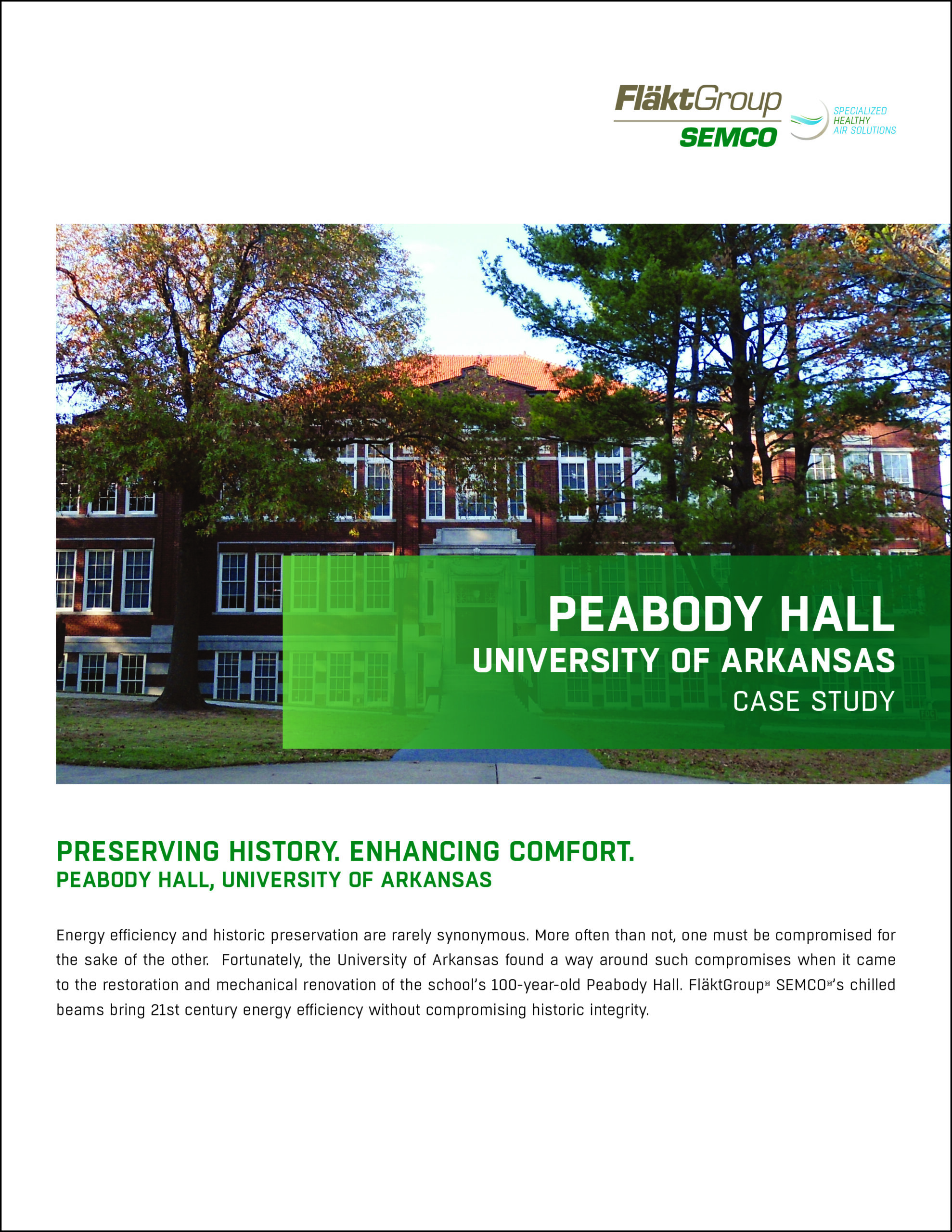
University of Arkansas: Peabody Hall
- Fayetteville, Arkansas
Peabody Hall, a 100‑year‑old historic building at the University of Arkansas, required a mechanical renovation that would address moisture issues while preserving original architectural features. Engineers selected chilled beams paired with a Pinnacle® primary ventilation system to meet cooling, ventilation, and humidity‑control needs. The combined system enabled energy‑efficient performance without compromising the building’s historic integrity.
Key Facts
- 100‑year‑old LEED‑certified building
- 27,230 sq. ft. facility
- Approximately 250 chilled beams installed
- One 9,000‑CFM Pinnacle® variable air volume energy recovery system
- Prior HVAC system unable to remove moisture effectively during cooling season
- Renovation cost: $8.5 million (all‑inclusive project)
- Moisture issues included plaster wall bubbling and mold remediation
- Post‑renovation humidity levels: 30–35% (first season), projected 40–45% in following years
- Chilled beam airflow is one‑half to one‑third of VAV or constant volume systems
Challenge
Modernize the comfort system of a historic building suffering from long‑term moisture problems without damaging architectural features such as tin ceilings and clay tile roofing.
Solution
Engineers implemented chilled beams throughout the building along with a FläktGroup SEMCO Pinnacle® primary ventilation system. The Pinnacle® unit provided dehumidified, preconditioned supply air to manage latent loads, enabling chilled beams to serve sensible cooling needs without condensation risk. The reduced ductwork and airflow requirements minimized intrusion into the building’s original architecture.
Results
- Achieved effective humidity control, reaching 30–35% humidity during the first cooling season
- Enabled preservation of high ceilings and historic interior elements
- Reduced ductwork and airflow requirements compared to VAV or constant‑volume systems
- Improved occupant comfort and indoor environmental quality
- Successfully dried the building after decades of moisture retention
“We found we were able to get the humidity down to 30–35% for the entire building by running the unit at maximum capacity.”
Hamid Habibi
Managing Principal
TME
Plan your next Education project with healthier, more efficient air.
We help engineers and owners design low-energy, code-compliant systems — backed by real-world results like this case.